
Specification-Grade Recovered Lumber (SRL™) — Non-structural
Recovered lumber, specified like any other input.
Northmark's infrastructure is designed to recover lumber from residential, light commercial and industrial applications, processing it into a graded, documented, non-structural material. The result is recovered wood that can be specified with the same confidence as stock you already procure.
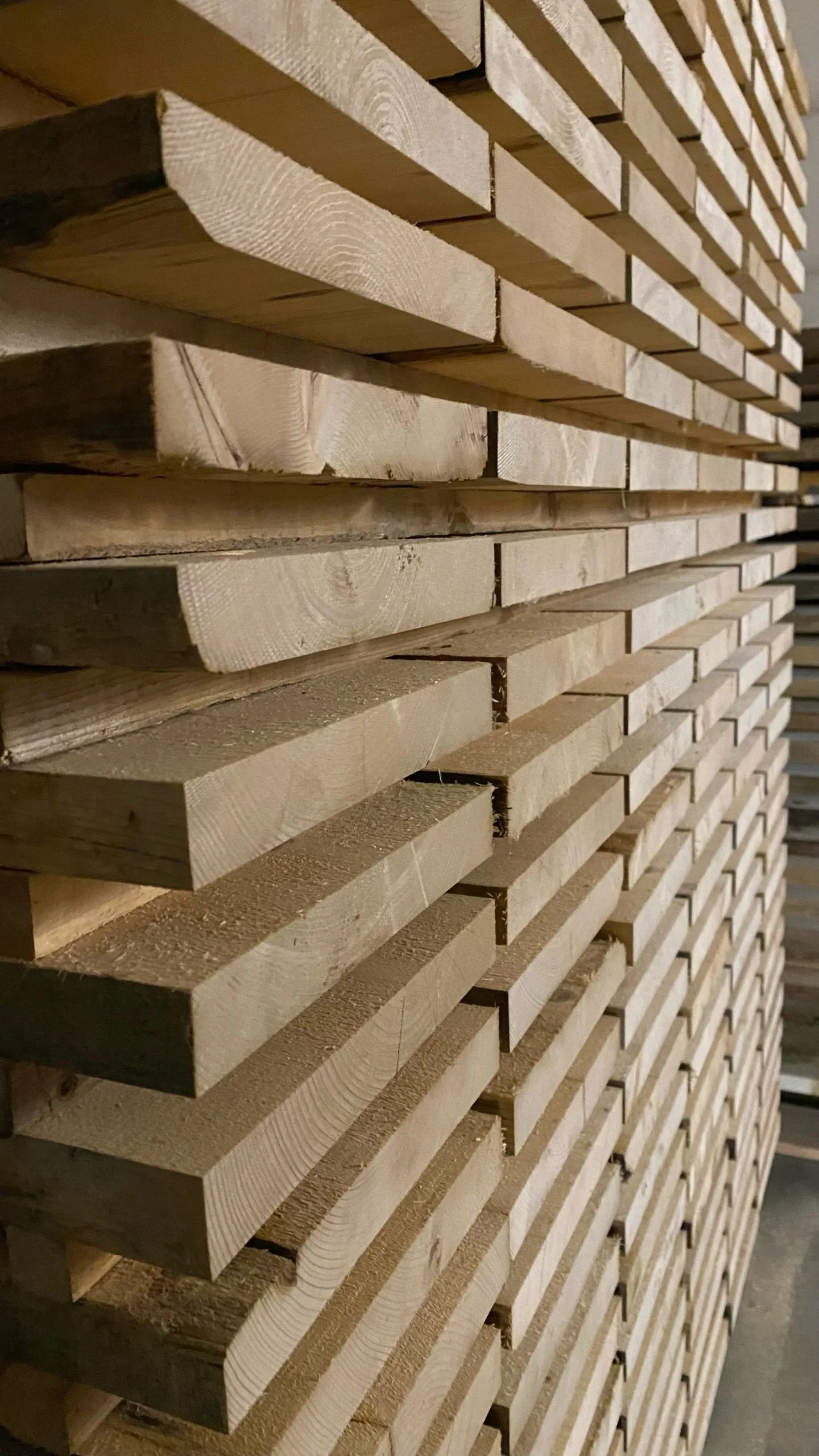
- Grading
- Documented, piece-level grade assignment
- Moisture
- Recorded on every unit
- Traceability
- Batch ID from source to sale
01 / The material premise
Finite material, treated as an industrial asset.
Lumber milled from old-growth timber still stands in Edmonton's older housing stock. Once it goes to landfill, it doesn't come back.
Northmark's Integrated Hub in Edmonton is designed to process this material into SRL, a documented material classification that turns it into a dependable supply for construction and manufacturing.
Definition — Material classification
Specification-Grade Recovered Lumber
Northmark's internal material classification for non-structural recovered wood. It sets the grading, moisture and traceability requirements recovered fibre must meet before it carries the SRL designation. SRL is governed by Northmark. It isn't a cosmetic label; it's a specification a buyer can hold a supplier to.
Designation: non-structural use only02 / The recovery system
A system that routes wood away from landfill and into supply chains.
Centralized processing replaces ad hoc salvage. Each stage is designed to produce the same result every time, not a one-off recovery.
01
Controlled disassembly
Only material recovered through certified panelized disassembly qualifies for SRL. Northmark is developing these protocols with All West Demolition. The result is a documented, auditable destination for recoverable wood from property owners and builders.
02
Industrial standardization
Every batch moves through the same sequence: sorted, graded, measured and moisture-recorded before it's released. That sequence is what turns salvage into a material that repeats.
03
Market enablement
Downstream requirements set recovery sequencing, processing tolerances and output formats. SRL is designed to move through existing wholesale channels, working with Trail Building Supplies, without custom pathways.
Throughput discipline
Volume is the point.
One pile of recovered wood is salvage. Documented volume moving through a governed recovery line is supply. The Edmonton hub is built for a capacity-led ramp, where throughput grows as commissioned equipment and verified recovery yield allow, not ahead of them. Volume without a specified buyer is inventory.
03 / System outputs
Three outputs, each built to slot into an existing workflow.
01 — Material
Specification-Grade Recovered Lumber (SRL™)
Graded, moisture-specified, non-structural recovered wood, processed as a predictable material input.
02 — Components (designed outputs)
Processed components
Panels, flooring blanks, S4S blank stock and dimensional blanks, produced to downstream specifications for finishing, millwork and fabrication.
03 — Records
Material documentation
Each SRL unit is designed to carry a Batch ID linking it to its source, recovery data and grade. That's the paperwork an institution or specifier needs to sign off. An Environmental Product Declaration for SRL is in development.
04 / Where material decisions are made
Built for the people who specify, source, and account for the material.
Supply side
Asset owners & developers
Managing end-of-life buildings that need a documented recovery pathway, not an ad hoc haul-off.
Demand side
Manufacturers & fabricators
Requiring reliable, non-structural material inputs that behave predictably, batch after batch.
Distribution
Wholesalers & distributors
Dependent on consistency, grading discipline and volume alignment to carry a new material without friction.
Accountability
Institutional procurement
Accountable for diversion performance, emissions outcomes and procurement compliance.
05 / Validation
Validation, on the record.
Northmark has secured non-dilutive public funding and applied research participation ahead of commissioning, on the strength of its recovery and processing approach.
$1.98M
Emissions Reduction Alberta Grant
$75K
City of Edmonton Edge Fund Grant
2×
Alberta Emerald Awards Finalist, 2024 / 2025
Circular Construction Canada
Memorandum of understanding. Applied research programme testing recovery, preparation and specification of salvaged wood, through August 2027.
Recycling Council of Alberta
Change Maker Award, 2025.
Northmark is pre-commercial. The Edmonton Integrated Hub is in development.
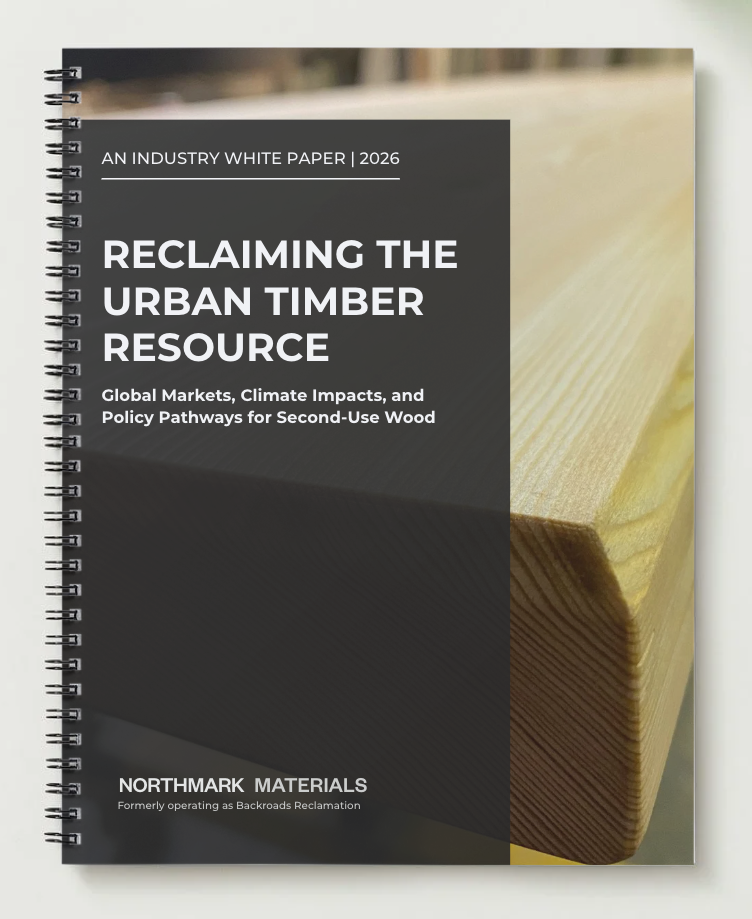
Technical report — Published January 2026
Reclaiming the Urban Timber Resource
Recovered demolition lumber stays marginal in most jurisdictions. The constraint is infrastructure, not material performance. This report examines the operating conditions required for second-use wood to function as a reliable, specification-grade material.
- Recovery logistics and centralized processing
- Asset-value modelling: diversion pathways compared with disposal
- How SRL classification supports predictable inputs
Where we are now
Northmark is pre-commercial. The Edmonton Integrated Hub is in development. Recovery, processing and supply-chain systems are being built deliberately, with market alignment and operational reliability ahead of volume.